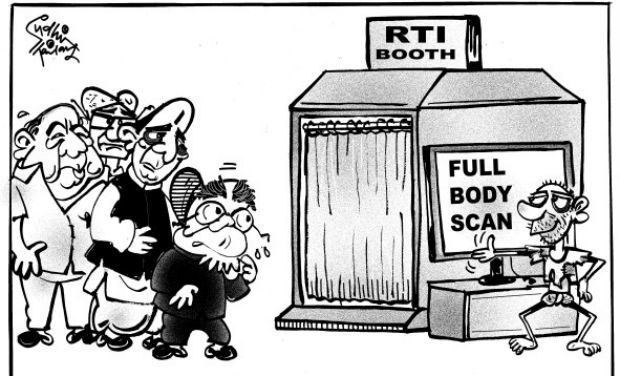
August,24,2015: The Government told the Supreme Court on Monday that political parties should not be brought under the ambit of Right to Information (RTI) Act by terming them ‘public authorities’ as it would not only hamper their smooth working but help political rivals to file pleas with malicious intention to seek information.
When the RTI Act was enacted, it was never visualised that politicial parties would be brought within the ambit of the transparency law, the Department of Personnel and Training (DoPT) said in an affidavit.
The affidavit said there were provisions in Representation of the People Act (RPA) 1951 and the Income Tax Act which brought necessary transparency about the financial aspects of a political party.
The government’s affidavit came in response to a notice issued to it on a plea to declare all national and regional political parties as “public authorities” to bring them under the ambit of the RTI Act.
The government maintained that the Central Information Commission (CIC) had made a “very liberal interpretation” of Section 2(h) of the RTI Act, which has led to an “erroneous” conclusion that political parties are public authorities.
The petition was filed by noted RTI activist Subhash Agarwal and Association for Democratic Reforms, an NGO whose legal battle led to the Supreme Court judgment in 2002 making it mandatory for electoral candidates to declare their criminal antecedents.
It arraigns political parties, including the Indian National Congress, Bharatiya Janata Party, Communist Party of India (Marxist), Communist Party of India, Nationalist Congress Party and Bahujan Samaj Party for not complying with repeated orders by the nation's top RTI body, Central Information Commission (CIC), to disclose assets.
The CIC, in both 2013 and March 16, 2015, had declared all national and regional political parties to be public authorities under the Right to Information Act, 2005. The petition argues that both orders were “final and binding”.
Earlier the petition filed before the SC wanted the apex court to direct national and regional political parties to disclose complete details about their income as well as expenditure, entire details of donations and funding received by them irrespective of the amount donated and full details of donors making donations to them and to electoral trusts.
The petition argued that political parties should come under the RTI law as they play a core role in governance, and in fact, enjoy a “stronghold” over their elected MPs and MLAs under Schedule 10 of the Constitution. The Schedule makes it compulsory for MPs and MLAs to abide by the directions of their parent parties, failing which the member stands to be disqualified.
Besides, it contended that it will be within the average voter's fundamental right to information to know the financial details of political parties to make an informed choice.
“Under Section 29A of the Representation of the People Act, 1951 all political parties must affirm their allegiance to the Constitution of India and such allegiance is made compulsory for the purpose of registration under sub-section (7) of Section 29A. Therefore, political parties so registered must furnish information to the public under the right of information under Article 19(1)(a) of the Constitution of India, since right of information has been held to be a part of freedom of speech and expression under Article 19(1)(a),” the petition, represented by advocate Prashant Bhushan, said.
It said the Law Commission of India in its 170th Report on ‘Reform of the Electoral Laws’ in May 1999 had also recommended for transparency in the functioning of political parties specially focusing on financial transparency and accountability in their functioning.
It further said the Law Commission of India in its 255th Report on Electoral Reforms in March 2015 has also proposed its recommendations on the issue of disclosure obligations of political parties.
Upon receipt of the petition Bench led by Chief Justice of India H.L. Dattu gave the political parties six weeks to file their responses on why they should not be declared as “public authorities” under the Right to Information Act 2005, making them liable to disclose their financial assets to the public.
Besides the Congress party and the BJP, the petition has arraigned the Communist Party of India (Marxist), Communist Party of India, Nationalist Congress Party and Bahujan Samaj Party.
The Election Commission and the Union of India through the Cabinet Secretary are also parties and will have to file their responses to the apex court.
Related Laws at LatestLaws.in-