"The effect of a verdict of acquittal pronounced by a competent Court on a lawful charge and after a lawful trial is not completely stated by saying that the person acquitted cannot be tried again for the same offence. To that it must be added that the verdict is binding and conclusive in all subsequent proceedings between the parties to the adjudication." -SC
With this significant observation, the Supreme Court opened its verdict in a case that raised fundamental questions about the boundaries of criminal litigation, the doctrine of finality in judicial findings, and the proper invocation of vicarious liability in corporate offences. The case involves a detailed examination of whether the criminal justice system permits re-litigation of a defense already disbelieved, and whether an individual can be prosecuted when the company he represents is not even arraigned.
Brief Facts:
The case stems from a business transaction with ID Packaging, a firm owned by respondent R.N. Tyagi. Tyagi issued 11 cheques between Dec 1997–Jan 1998, 7 of which were dishonoured twice. Ruchira Papers filed a complaint under Section 138 of the Negotiable Instruments Act (NI Act), leading to Tyagi’s conviction in 2002. His defence that the liability had been cleared via three demand drafts was rejected, and his conviction was upheld in appeal.
In 2012, all disputes were settled through a one-time payment of ₹3,20,385, recorded in a High Court order that disposed of related civil and criminal cases.
Meanwhile, Tyagi filed an application under Section 156(3) CrPC alleging that Garg fraudulently re-presented the cheques despite receiving payment, leading to FIR No. 549 of 1998. The Magistrate took cognizance and summoned Garg.
His plea for quashing the chargesheet and summoning order was rejected, leading to the present appeal before the Supreme Court.
Contentions of the Petitioner:
Senior Advocate Mr. Siddharth Aggarwal, appearing for the appellant S.C. Garg, argued that the prosecution is unsustainable as the company, allegedly the principal offender, was not arrayed as an accused, and no specific allegations were made against Garg in his personal capacity. He contended that the criminal case was filed as a retaliatory measure after Tyagi’s conviction under Section 138 NI Act and the subsequent compromise. Additionally, the summoning order lacked any reasoning, reflecting non-application of judicial mind.
Contentions of the Respondent:
Counsel for the respondent, Mr. Vikas Bansal, maintained that the matter involves a triable issue. He argued that Garg allegedly encashed four cheques even after Tyagi had already cleared the dues via separate demand drafts, amounting to double recovery and thus constituting cheating. Whether such double payment occurred is a question of fact to be determined at trial.
Observation of the Court:
The Supreme Court underscored the impermissibility of criminal proceedings founded upon factual assertions that had already been judicially examined and rejected in prior adjudication under Section 138 of the Negotiable Instruments Act, 1881. The Court found that the present complaint initiated by Garg against Tyagi hinged on the very defense of "payment by demand drafts," which had earlier been raised and specifically disbelieved in the concluded cheque bounce proceedings.
The Bench referred to the findings of the Magistrate recorded in the order dated 25.10.2002, noting that: “From this statement of account Ex.P-16, to can be safety presumed that these demand drafts pertaining to some other liability of the accused persons and these demand drafts were not issued to liquidate the liability of impugned cheques Ex.P-2 to Ex.P-8.”
This conclusion, the Court noted, was upheld by the Sessions Court which concurred that the evidence led by the defence failed to establish that the demand drafts related to the dishonoured cheques. Accordingly, the Court held that these factual findings, rendered by a competent criminal court, attained finality and were binding on the parties.
The Court observed: “It is thus apparent that the finding recorded by the jurisdictional criminal court in 138 NI Act proceedings between the parties would be binding to both the parties in any subsequent proceedings involving the same issue.”
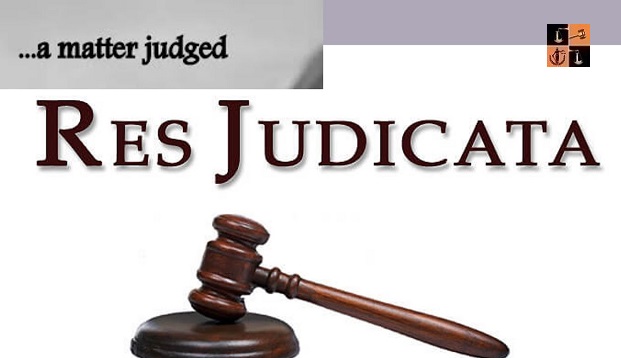
Turning to the applicability of the doctrine of res judicata in criminal proceedings, the Supreme Court acknowledged the divergence in judicial opinion. It noted that while decisions such as Devendra & Ors. v. State of U.P. (2009) and Muskan Enterprises v. State of Punjab (2024) had held that res judicata did not apply to criminal matters, those rulings arose in the context of petitions under Section 482 CrPC where no adjudication on merits had occurred.
In contrast, earlier and binding precedent such as Pritam Singh v. State of Punjab (1956), Bhagat Ram v. State of Rajasthan (1972), and State of Rajasthan v. Tarachand Jain (1974), rendered by larger Benches, affirmed the application of res judicata in criminal jurisprudence. Referring to Pritam Singh, the Court cited with approval the Privy Council’s dictum in Sambasivam v. Public Prosecutor, Federation of Malaya (1950): “The maxim ‘res judicata pro veritate accipitur’ is no less applicable to criminal than to civil proceedings.”
Reconciling the conflicting strands of case law, the Court clarified: “...these two cases [Devendra and Muskan Enterprises] are totally distinguishable.”
It further emphasized the binding effect of decisions by larger Benches: “Pritam Singh (supra) is binding insofar as the issue concerning the applicability of principle of res judicata in a criminal proceeding is concerned.”
Applying this principle to the facts at hand, the Court concluded that Tyagi, having already failed in his defense of payment through demand drafts in the earlier trial, could not now turn around and initiate prosecution on that very ground. It held: “Tyagi cannot maintain a prosecution on the basis of allegations which were precisely his defence in the earlier proceedings wherein he was an accused. Thus, the present criminal proceedings deserve to be quashed on this ground alone.”
Additionally, the Court delved into the question of corporate liability and vicarious prosecution. It highlighted that the impugned cheques and corresponding demand drafts pertained to inter-corporate transactions, and there was no material indicating personal dealings between Tyagi and Garg. Citing Sharad Kumar Sanghi v. Sangita Rane (2015), the Court reiterated the fundamental requirement of arraigning the company when invoking vicarious liability: “When the company has not been arraigned as an accused, such an order could not have been passed.”
This principle was reaffirmed by the Court’s ruling in Dayle De’ Souza v. Government of India (2021), where it held that officers of a company cannot be prosecuted in isolation unless the company itself is made an accused
The Court held that the present prosecution was doubly vitiated, first, by being a re-litigation of a factual issue already decided, and second, by its failure to meet the statutory preconditions for vicarious liability. On both grounds, the continuation of proceedings was declared legally unsustainable and accordingly quashed.
The decision of the Court:
The appeal was allowed and the impugned criminal proceedings instituted against the appellant for offences under Section 420 IPC were quashed. Criminal Case No. 7489 of 2002 arising out of Crime No. 13 of 1998, pending before the Chief Judicial Magistrate, Ghaziabad, was accordingly quashed.
Case Title: S.C. Garg v. State Of Uttar Pradesh & Anr.
Case no: CRIMINAL APPEAL NO(s). 438 OF 2018
Citation: 2025 Latest Caselaw 377 SC
Coram: Hon'ble Mr. Justice Sanjay Karol and Hon'ble Mr. Justice Manmohan
Advocate for Petitioner: Adv. Qurratulain
Advocate for Respondent: Adv. Danish Zubair Khan [For Respondent-2] and Adv. Ruchira Goel [For Respondent-1]